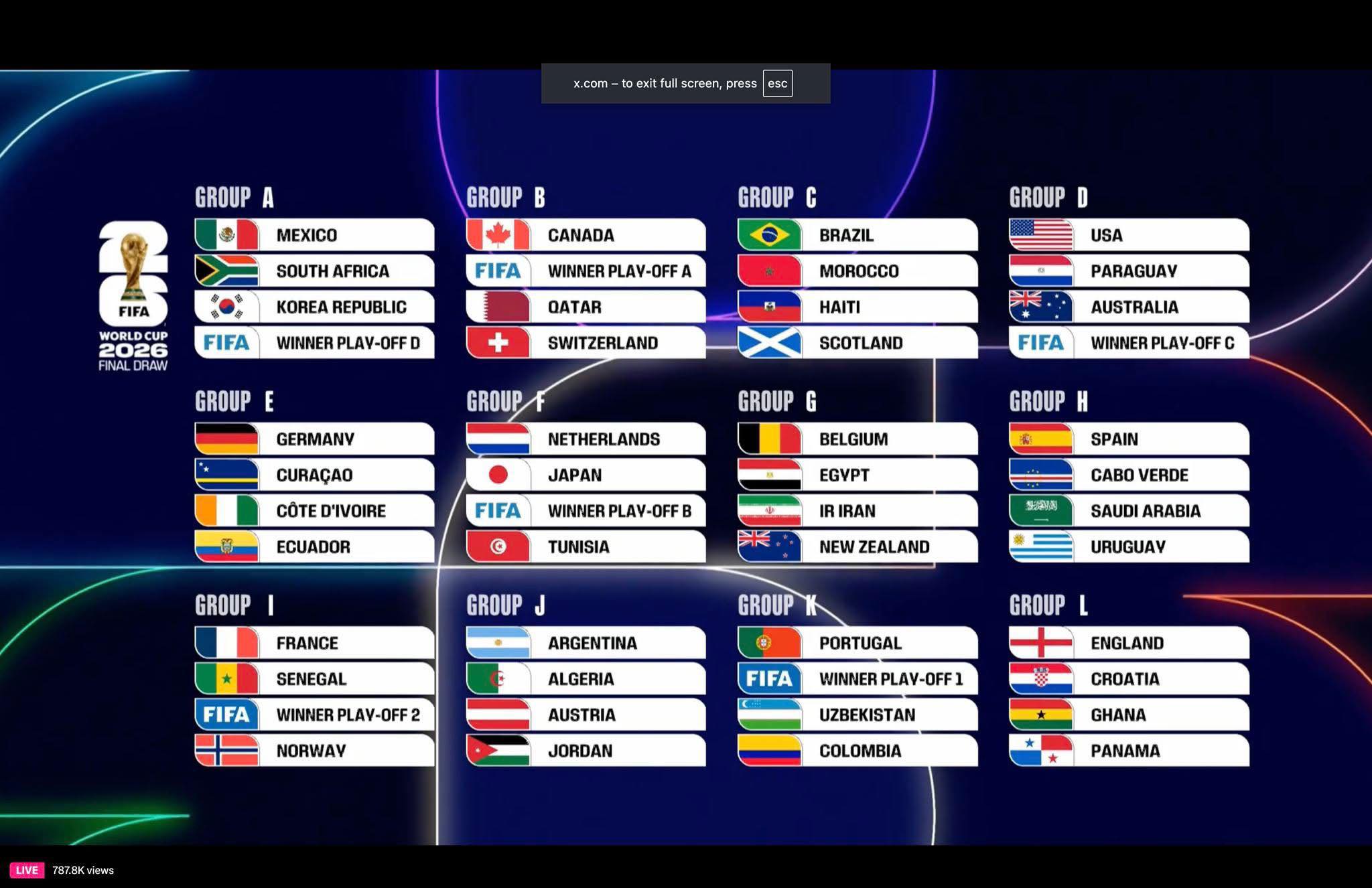

Today — December 5, 2025 — at the John F. Kennedy Center for the Performing Arts in Washington, D.C., the draw for the 2026 World Cup was held. The draw finalizes which teams will face which in the group stage of what will be the largest World Cup ever, set to be co-hosted by United States, Canada and Mexico next summer.
With 48 national teams participating — up from the usual 32 — the draw was extra important, because it sets the stage for a tournament like no other.
Some headline groupings already have fans excited — while others are dreading potential “groups of death.”
🧩 The New Format — Explained Simply
• 48 Teams. 12 Groups of 4.
- Instead of 32 teams as in recent World Cups, 48 teams will compete.
- The 48 teams are divided into 12 groups, labeled Group A to Group L.
- Each group has four teams.
• The Pots & Seeding — Who Goes Where
To keep things balanced, teams were sorted into four “pots” based on rankings and status before the draw. (SI)
- Pot 1: Contains the three host nations (USA, Canada, Mexico) plus the nine highest-ranked qualified teams.
- Pots 2, 3, 4: Contain the remaining teams, ordered roughly by ranking. Also — the six teams that haven’t yet qualified (because they’ll come through playoffs in March 2026) are automatically placed into Pot 4.
During the draw, each group ends up with exactly one team from each pot — so that in theory, every group has a mix of stronger and less-strong teams, helping balance the overall competition.
• No Overlapping Confederations — Mostly
To avoid too many similar-region teams clashing early:
- Teams from the same continental confederation generally cannot be drawn into the same group — except for Europe (UEFA), which has more teams competing than there are groups.
- For European teams, a group may contain one or two UEFA nations, but no more.
This rule helps ensure global diversity in each group and reduces early heavy regional clashes.
• How to Advance: More Teams, More Chances
Because there are 48 teams and 12 groups, the knockout structure changes slightly:
- After group play, the top two teams from each group (that’s 24 total) automatically advance.
- Additionally, the eight best third-place teams across all groups also advance — giving more teams a shot at the knockout stage.
- That brings the total to 32 teams in the knockout round.
From there, it’s the usual single-elimination: Round of 32 → Round of 16 → Quarterfinals → Semifinals → Final. (SI)
Because of the larger field, a team reaching the final could now play 8 matches (instead of 7 in the older 32-team format).
✅ Why This Format Is a Big Deal — What It Means for Fans & Teams
- More nations get a chance. Smaller or historically underdog countries now have better odds of making it to a major global stage.
- More drama & surprises. With eight third-placed teams advancing, the group stage won’t be as cut-and-dry — a couple of good results could send underdogs deep.
- More games. More teams + more knockout entrants = more matches, more excitement, and more viewers worldwide.
- Balanced groups — at least in theory. The pot and confederation rules aim to avoid “groups of death” that are too stacked, and give all teams a fair shot.
- New strategic dynamics. Teams might approach the group stage differently — maybe going for third place as a realistic path, or treating early games as tactical setups for later ones.
📌 What Stood Out From Today’s Draw
- The roster of 48 teams is now final (with a few play-off spots still to fill) — meaning the path to the trophy is mapped out for most nations.
- Some major footballing powers were placed in groups that will test them early — while others landed in what many consider “easier” groups, giving them a potentially smoother path to knockout stages.
- The expansion and revised format mean more opportunity for underdog stories, which could make 2026 one of the most unpredictable and exciting World Cups yet.
Leave a Reply